

PART 1 | PANDA HISTORY & INTRODUCTION
A Crosley Panda Survivor
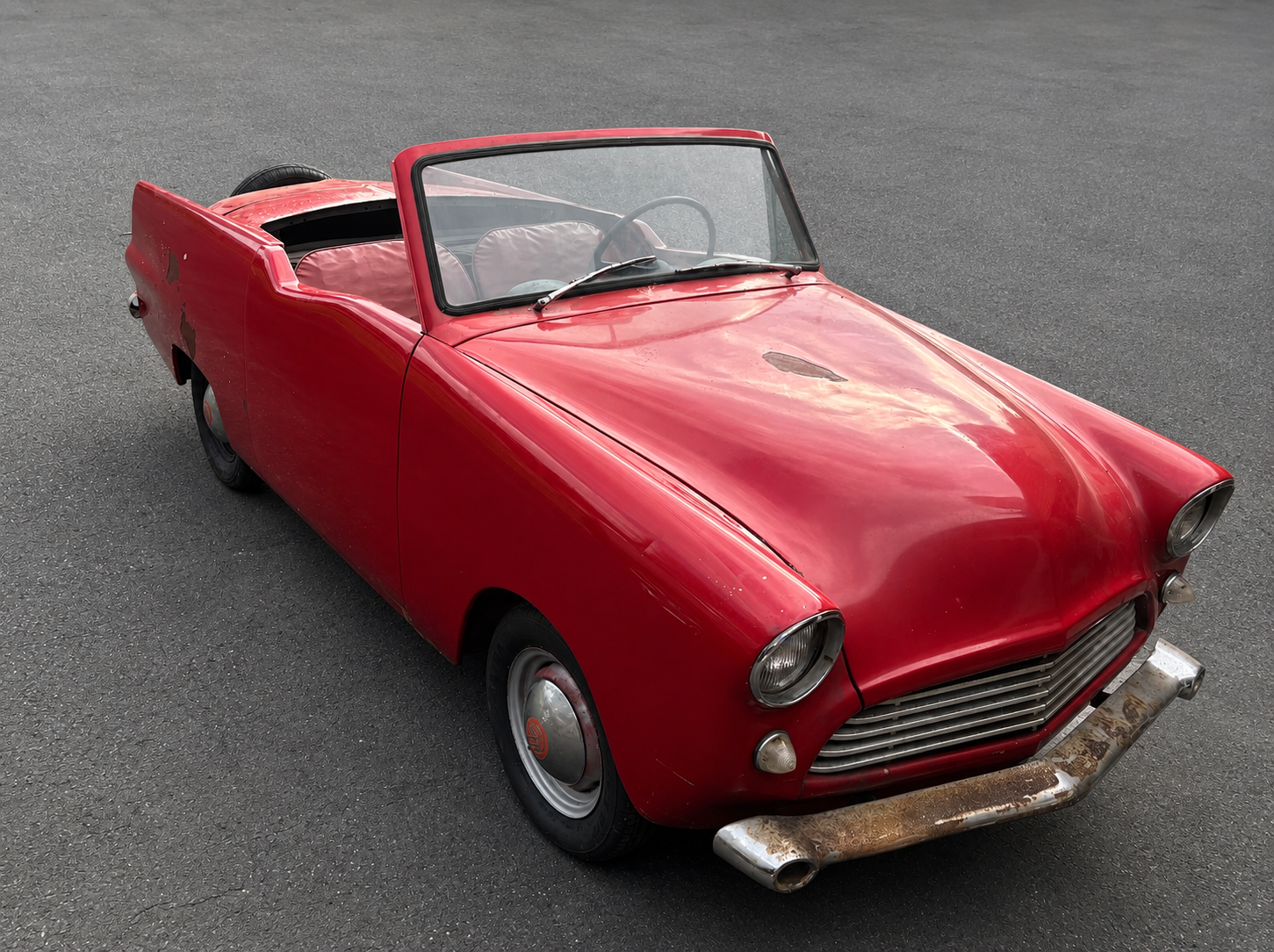
With the demise and “sell-off” of Powel Crosley’s automobile and related appliance empire beginning in 1952, the desire to continue with portions of his small car enterprise ebbed and flowed for a few more years. Crosley engines appeared in marine use, generators, refrigeration units, forklifts, and other industrial applications. Interestingly, there was a short flurry of interest in continuing with Powel’s micro car innovations as well. One attempt to continue with the Crosley “post-war baby cars” legacy was initiated in Kansas City, Missouri by Finn S. Hudson. Hudson, a Norwegian immigrant, former Crosley dealer, and mechanical engineer, established Small Cars, Inc. in 1953. His goal was to manufacture the Panda, a small Crosley derivative, described as a “small utility vehicle” — more like a sports car — powered by the durable Crosley engine.
As Robert D. Cunningham noted in “Crosley Powered Roadster Proposal Resulted in Panda-Monium”,
“The one-piece Panda body would feature low-cut sides similar to the Crosley Hotshot, a rounded rear deck and long, smooth hood interrupted only by bullet-shaped headlights at the corners. Front bumpers would extend rearward to the front wheels and rear bumpers would extend forward across the sides to the cockpit openings. All four wheels would be enveloped, similar to the treatment Nash had employed on its larger cars.”
— Robert D. Cunningham
By the autumn of 1954, with the Panda Series I, Hudson had shortened a 1952 Crosley chassis from a wheelbase of 85 inches to just 70 and installed his first fiberglass roadster body.
As the Panda Series I (1953–54) and Series II (1955) prototypes (12) were being developed, Finn Hudson entered into negotiations with George Drumm and Crosley Parts–Service Motor company owner, Ed Herzog. At the time, Herzog was a former Crosley dealer and owner of the largest Crosley parts distributor. With Herzog’s extensive parts inventory, Hudson felt this deal would keep Panda builders supplied with sufficient parts to ambitiously accommodate the estimated production from 3,600 to 10,000 cars annually. Further, Hudson was so excited about the Drumm/Herzog deal that he convinced a Kansas City attorney, W.C. Boatright, to help supply additional financing for this expansion.
Herzog reported twelve (12) pilot Pandas had been assembled and mass production was just a few months away. Prices would range between $1,000 for the base model and $1,500 for the DeLuxe. At the time, Small Cars magazine released an illustration of the DeLuxe Panda (possibly Series II) equipped with:
- ›Oversized bumper guards
- ›Two-toned paint with bright metal trim
- ›Concave grille
- ›Hidden door hinges
- ›Squared-off wheel well openings
- ›A one-piece windshield
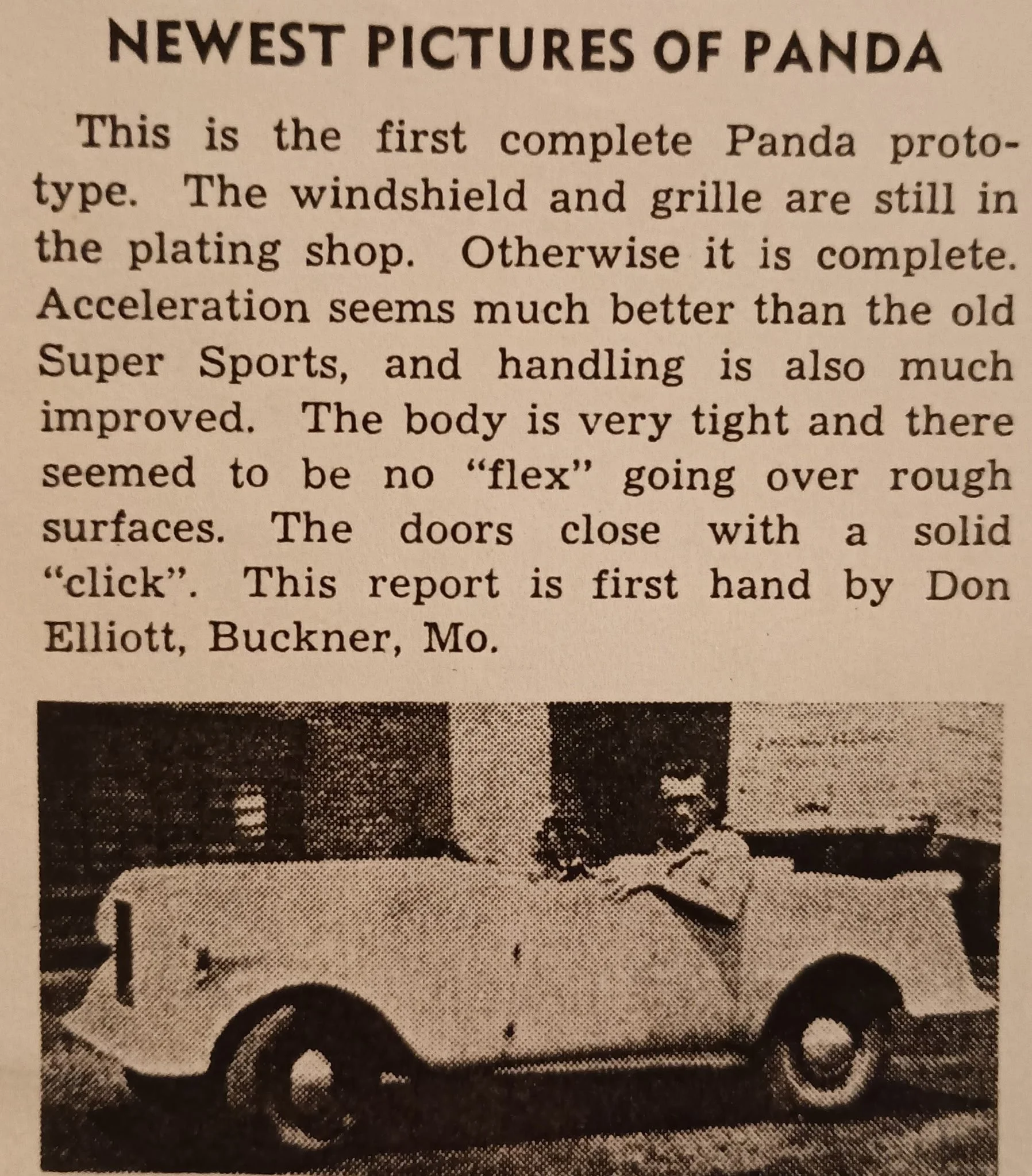
However, the actual prototype looked similar but included additional changes, including lower-profile doors, chrome trim that extended across the rear fenders, and a rear-mounted Continental spare tire.
· Three Types, Twelve Prototypes
Research suggests there were actually three (3) “Types” of Panda, with a total production estimate of twelve (12) prototypes. While 12 “pilot” units are the commonly cited figure, they were not all identical. The evolution was roughly:
-
Phase 1
1953 — Early prototypes used standard Crosley CIBA (Cast Iron Block Assembly) engines. These were essentially rebodied Crosley Hotshots or Super Sports.
-
Phase 2
1954–1955 — The design evolved with a more distinct “Panda” look — a concave grille, protruding headlights, and small tail fins, quite different and lower-profiled than the Phase 1 car.
-
Phase 3
1955–1956 — When Crosley folded, the engine rights went to Aerojet General, and subsequent Pandas used an Aerojet (Crosley) platform. These engines were marketed as “Aerojet” and were slightly more refined than the early Cast Iron Block versions.
Best surviving documentation suggests the following breakdown:
| Year | Type | Quantity Made |
|---|---|---|
| 1953 | Type I, steel | 4–5 |
| 1955 | Type II, fiberglass | 4–5 |
| 1956 | Type III, fiberglass Aerojet | 1–2 |
| Total Prototypes | 10–12 | |
Most auto historians and collectors agree 12 is the most accurate total.
By early 1956, Hudson’s Panda expenses continued to mount and the entire program soon began to collapse. “All of the Panda pilot cars” (12 in total) soon disappeared as Small Cars, Inc.’s financial debts were settled. With the final dissolution, Service Motors (Herzog) acquired Hudson’s parts and tooling. However, when it was soon obvious that neither Crosleys nor Pandas would ever return, the Panda tooling was sold at scrap-metal prices.
Minimal Panda documentation is available today, and vague rumors persist among a diminishing few about the survival of any of the original 12 prototypes. What emerges from the scant available information is that there appear to have been three design series across the Panda’s short 1953–56 development. What follows presents the case for a surviving Panda Series II prototype — and the documentation behind it.
· A “Surviving” Panda Owner’s Story
When did you first see this car?
In about 2015, I was contacted by a man named Baker from Homestead, Massachusetts. After years of running an auto-body shop, restoring Corvettes, and collecting Crosleys, he was selling everything in preparation for his planned retirement to Las Vegas. My friend, Kerm, and I went to Homestead to see his collection.
Mr. Baker was also a huge, well-known Crosley collector in the area. On site, he had 9 solid cars stored in 3 closed trailers and an entire open cowbarn with over 20 more Crosleys in varied conditions. He had another 4 Crosleys in an “upstairs” barn and 4 more under his house. At the top of a small horse barn was additional storage full of engine parts, car parts, gauges, and even Crosley sheet-metal parts. Finally, and more importantly, down from his house, I saw the Panda sitting outside along with a Crofton bug. The owner commented that he had purchased all of Herzog’s Service Motor’s inventory circa the late 1970’s.
How did you get this Panda?
On this trip, I bought a Crosley convertible. In addition, I hauled away 4 trailers filled with parts in my Suburban. The Panda was included in the entire deal. However, my friend Kerm, who came with me, saw the Panda and said he would buy it and promised me he would restore it.
With the passing of time, I had little contact with Kerm after he purchased the Panda. Sadly, in 2024, Kerm’s son called to tell me his dad had passed away, and the family wanted to get rid of all of his cars and parts — would I help them? The first question I had for his son was, “Did your father do anything with the original Panda he bought years earlier?” He said, “It was in a box trailer on the property,” and that his dad had only taken parts off it from time to time. Knowing exactly what my friend had originally purchased a decade earlier, and being convinced it was close to the original car, I purchased the Panda from Kerm’s family.
Tell me a bit of your Panda’s history, as far as you know?
When my friend was originally buying the Massachusetts cars and parts, the owner said the car was one of a few “prototypes” made and was given to Boatright’s daughter as part of repayment after the Panda company’s failure. (W.C. Boatright was the original attorney working on the development of the Panda with Hudson and Herzog.) As the previous owner’s story went, with the collapse of Panda, Boatright was partially repaid with one of the last of the remaining prototypes. A fire several years ago at the Boatright residence “claimed” that the final fiberglass prototype was destroyed.
Did you find any information that might confirm this car’s authenticity?
Later, after I purchased it, I had a young guy working with me while I helped him restore a Crosley. He was on eBay and found several pieces of literature about Crosleys and other cars. In that stash he found a brochure including several artistic renderings of the Panda (see support material in Part II of this series) and gave them to me. To date, outside of minimal documentation and extensive “hearsay” and unsubstantiated opinion, little information is available documenting any “surviving” Pandas. This one is different.
What specific features confirm its authenticity to you?
Bob Cunningham, in his early, seminal article on the Panda’s unique features, noted:
“The one-piece Panda body would feature low-cut sides similar to the Crosley Hotshot, a rounded rear deck and long, smooth hood interrupted only by bullet-shaped headlights at the corners. Front bumpers would extend rearward to the front wheels and rear bumpers would extend forward across the sides to the cockpit openings. All four wheels would be enveloped, similar to the treatment Nash had employed on its larger cars.”
Below are several Panda DeLuxe Series II original photos compared to the “surviving” Panda Series II in question, validating the similarities with the original Kansas City photo.
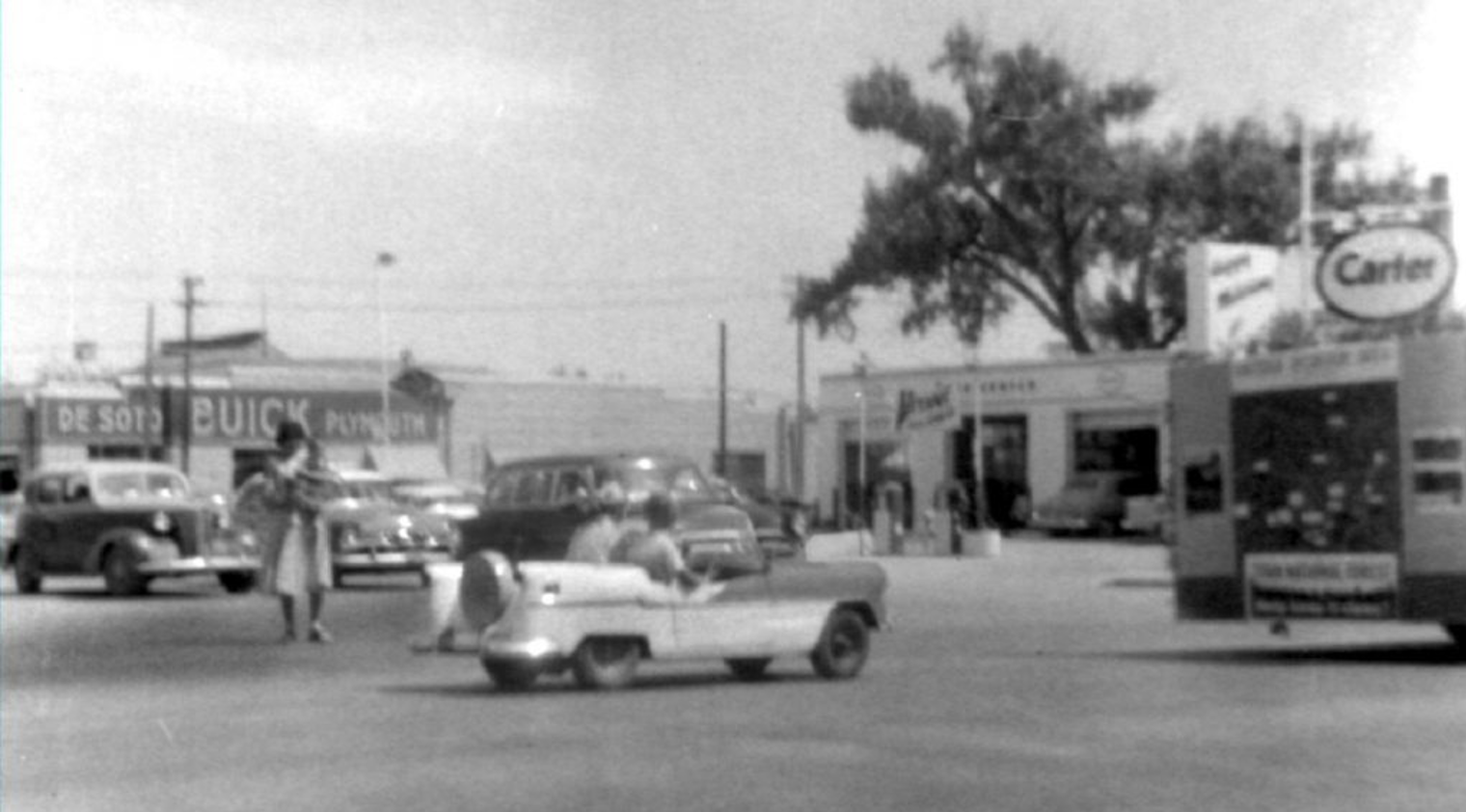
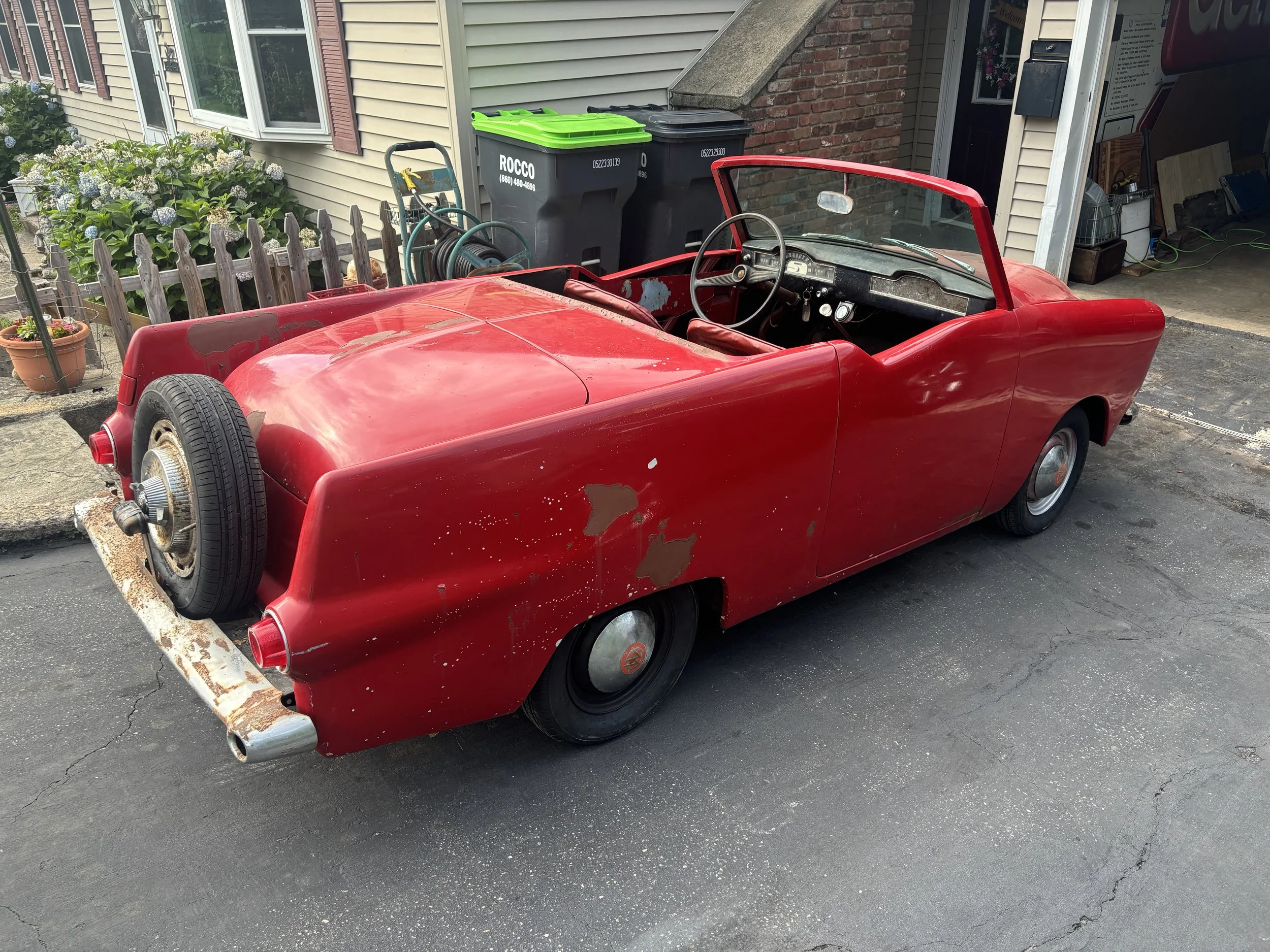
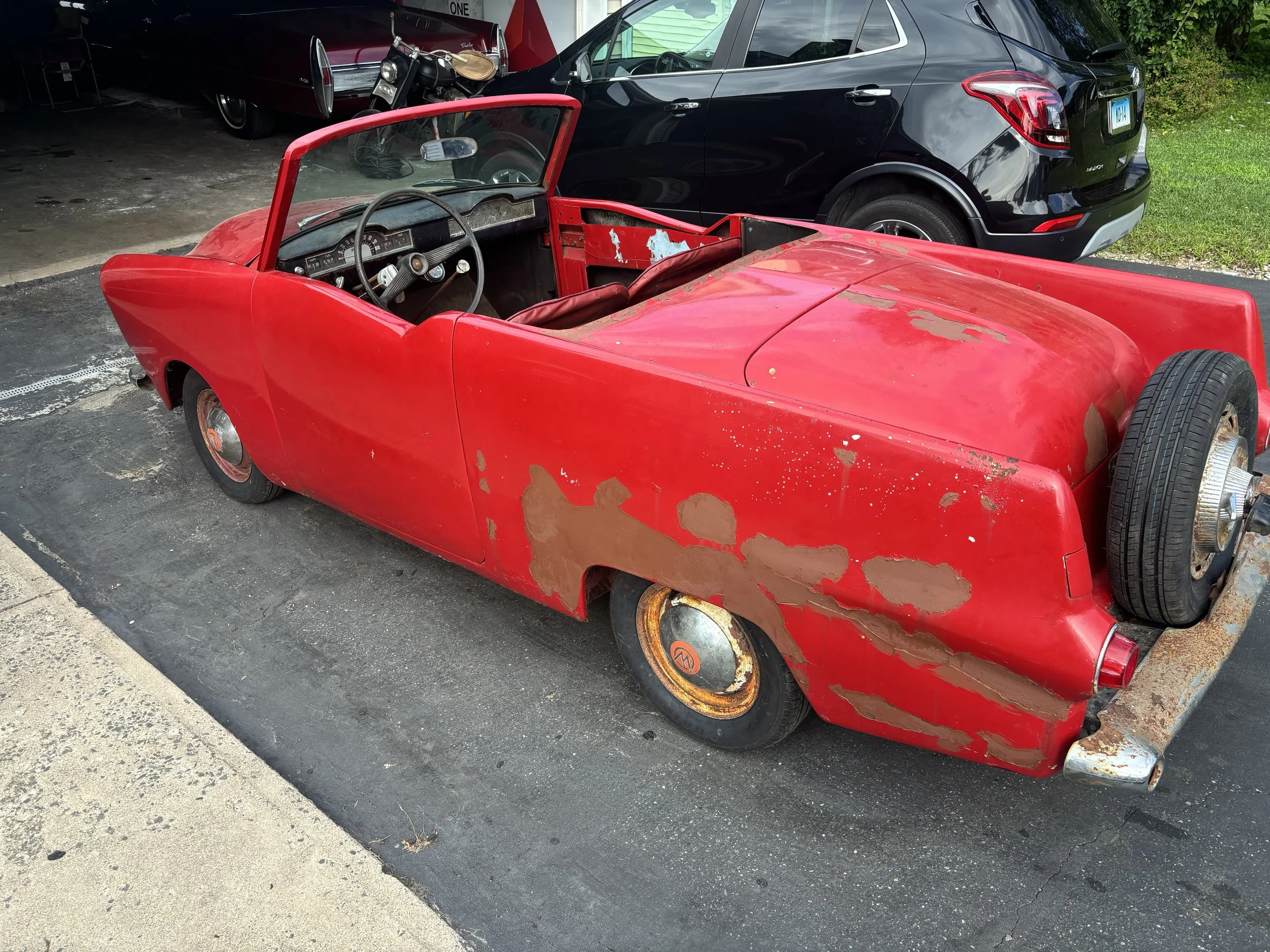
Note the similarity of the rear wheel cutouts and the fin extension notch forward into the cab.
Coming Soon — Part II
Stay tuned for Part II — the final chapter in the Panda Survivor series.
Part I gave a brief overview of the Panda, its three models, and an introduction to the surviving Panda II. Part II continues to validate the vehicle as a single surviving prototype — comparing an existing original Panda brochure (circa 1955) with current survivor photos and manufacturing details that demonstrate its authenticity.